AI for retail: a practical guide, cases and ROI
A practical guide for retailers and wholesalers on how to apply AI in a tangible, measurable and profitable way, with real cases.

Manuel Gros
Growth and Sales Advisor
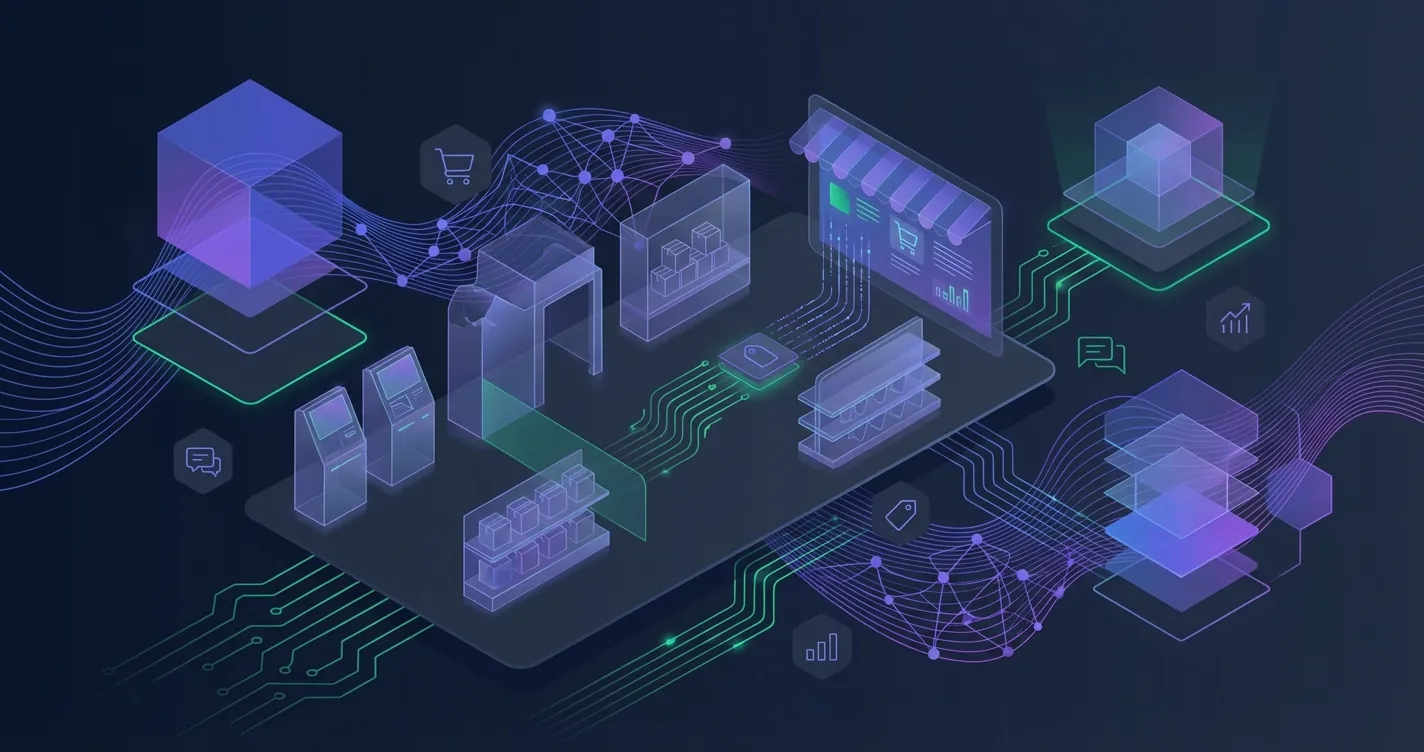
The adoption of AI for retail is redefining the way businesses understand, serve and retain their customers. From personalization to inventory optimization, artificial intelligence has become the new engine of efficiency and growth. This article aims to offer a practical guide so that retailers and wholesalers, whatever their size or technological maturity, can understand how to apply AI in a tangible, measurable and profitable way — drawing on real cases and accessible technologies like the ones nBlock drives in Latin America.
1. Introduction and the AI-for-retail landscape
The rise of Temu, with its surgical precision in marketing and ultra-competitive prices, set off a quiet alarm across the entire retail ecosystem. What some see as a threat, others see as an inspiration: how does it manage to operate so efficiently? The answer lies in its intensive use of data, automation and artificial intelligence for retail.
Today, artificial intelligence is no longer a privilege of global giants but a tool within reach of any retailer or wholesaler willing to modernize their operation.
1.1 Context, benefits and the goals of this article
Retail is at an inflection point. Margins are tightening, customers compare everything, and loyalty depends on the experience. AI for retail answers that context with three big benefits: personalization, efficiency and predictability.
The goal of this article is to show how to implement AI realistically, with low-code tools, without depending on large budgets or technical teams. AI can be applied incrementally, producing fast, measurable results even in mid-sized or regional businesses.
1.2 Definitions and scope: AI, ML and generative AI
In the world of AI for retail, three key concepts sit side by side. Artificial intelligence (AI) covers any system that simulates human intelligence. Machine learning (ML) lets those systems learn from data to improve without constant intervention. Generative AI, for its part, creates content — text, images or recommendations — from learned patterns. In retail, this translates into models that predict demand, recommend products or generate descriptions automatically. Understanding these differences helps you pick the right tool for the commercial challenge at hand.
1.3 Market size and adoption among large retailers
The global market for AI in retail already exceeds 10 billion dollars and is growing more than 25% a year. Amazon, Walmart and Carrefour apply AI to segment customers, adjust prices and plan inventory. But the real revolution is happening in the SME ecosystem: thanks to modular platforms like nBlock, local shops and regional chains can implement prediction algorithms or virtual assistants without infrastructure of their own. Technological democratization is transforming Latin American retail, which now competes with global platforms.
2. AI for SMEs and local retailers
AI for retail is not exclusive to the big chains. More and more SMEs, regional supermarkets and local distributors are starting to bring in artificial intelligence to solve concrete challenges: understanding their customers better, anticipating demand and improving margins without large investments. Modern solutions — modular, accessible and easy to implement — make tangible results possible within weeks. In this chapter we will look at how to adopt generative AI for retail and predictive models without being a programming expert or having a corporate budget.
2.1 Cost-effective low-code and SaaS options
Today there are low-code and SaaS platforms that make adopting AI for retail straightforward at controlled cost. Instead of developing bespoke systems, retailers can use off-the-shelf components — AI product recommenders, predictive demand analysis or conversational virtual assistants — that integrate easily with their CRM or POS. Solutions like nBlock democratize access to AI through modular blocks that solve specific problems, with no need for internal technical teams or months-long projects. That makes AI a viable investment rather than a luxury.
2.2 Migrating from spreadsheets to ML
The most common step for SMEs that want to get started with AI for retail is evolving from spreadsheets toward simple machine learning (ML) models. Many teams already record sales, stock and product turnover; the difference lies in using that data to predict. With accessible tools it is possible to implement AI inventory forecasting models, or automatic replenishment and smart inventory, which suggest what to buy, when and how much. That is how intuition turns into knowledge you can act on profitably.
2.3 Practical cases on small budgets
There are plenty of examples of AI for retail applied on a low budget: bakeries optimizing daily production with predictive demand analysis, clothing shops implementing AI product recommenders, or hardware stores using retail chatbots to handle queries outside business hours. All of them share one principle: start with a small case, measure results and scale. AI does not replace the local merchant's closeness to their customers; it amplifies it. With a practical approach, results can be visible within a few weeks.
3. Personalization and recommendations with AI for retail
AI-driven chatbots are redefining the relationship between customer and brand. Instead of relying solely on call centres or email, retailers can offer immediate, personalized support available 24/7.
The key is combining the speed of algorithms with human empathy: every conversation becomes an opportunity to sell, to build loyalty or to learn. This section explores how conversational assistants can be woven naturally into commercial flows, creating efficiency without losing warmth.
3.1 How it works: behavioural data and algorithms
Personalization in AI for retail rests on collecting and analysing behavioural data: browsing, purchase history, frequency and preferences. With that data, machine learning algorithms identify patterns and anticipate needs. They can recommend complementary products, adjust promotions or segment customers automatically. The secret lies in combining diverse sources — online store, POS, CRM — to build a 360° view of the customer. That is how a retailer moves from mass marketing to relevant, one-to-one marketing.
3.2 Capabilities: smart search and real-time recommendations
AI for retail strengthens search and recommendation engines, delivering more precise and personalized results. The systems interpret the user's intent, context and semantics. That makes it possible to surface products even when the exact name is not typed, or to suggest complementary items at the ideal moment. Real-time recommendation models also update constantly according to customer behaviour, which lifts conversion and average basket size. In e-commerce and in connected physical stores, the difference is immediate and measurable.
3.3 Omnichannel orchestration and clienteling
Omnichannel orchestration is one of the great contributions of AI for retail. It keeps the physical and digital worlds coherent: prices, promotions, recommendations and support. The algorithms unify interactions across channels and help sales staff deliver a personalized "clienteling" experience. Knowing what the customer bought, what they looked at on the website and what they asked over WhatsApp makes it possible to offer them exactly what they need. This applied intelligence increases loyalty and optimizes every point of contact.
3.4 Privacy, transparency and user control
Personalization has to go hand in hand with trust. In AI for retail, privacy and transparency are fundamental. Consumers value knowing how their data is used and being able to decide what they share. Implementing clear policies, anonymizing sensitive information and complying with regulations (GDPR or its regional equivalents) does not only avoid penalties: it builds trust and improves the customer relationship. Responsible AI is at once a competitive advantage and a brand differentiator.
4. Chatbots and virtual assistants for support and sales
Retail profitability depends to a large degree on how much you sell, how much you buy and when you do it. AI for retail offers a unique advantage: anticipating demand precisely.
Thanks to machine learning models trained on historical, seasonal and contextual data, it is possible to project future behaviour and make decisions based on evidence rather than intuition.
Here we will see how retailers can apply prediction, automate replenishment and even anticipate trends, connecting data analysis to daily business decisions.
4.1 Conversational capabilities and 24/7 availability
Chatbots powered by AI for retail are no longer simple canned responses. Thanks to generative AI they understand intent, context and tone, delivering fluid and empathetic support. They are available 24/7, they reduce operational load and they improve the customer experience. From answering simple queries to guiding the purchase process, virtual assistants are now an extension of the sales and support team, able to operate across multiple channels: web, WhatsApp, social media or even interactive kiosks.
4.2 Use cases: support, incidents and contextual upselling
The main use cases for AI for retail in chatbots include immediate support, resolving incidents, order tracking and contextual cross-selling. For example, if a customer asks about a size that is out of stock, the bot can suggest similar products or alert them when stock arrives. In other cases it identifies upselling opportunities, recommending accessories or premium versions. The impact is direct: less friction, more satisfaction and higher conversion, without increasing human costs or losing closeness.
4.3 Implementation practices and hand-off to a human
Implementing effective chatbots requires a good data strategy and conversational flow. In AI for retail, the key lies in defining when the bot resolves and when it transfers to a human. A smooth hand-off guarantees continuity and avoids frustration. It is also essential to train the models on real support and sales data, measure satisfaction and adjust responses. The result: hybrid support that combines automated efficiency with human empathy, striking an optimal balance for the customer experience.
5. Demand and inventory forecasting
In markets as volatile as retail, setting prices is no longer a static process. Dynamic price optimization with AI makes it possible to adjust strategy in real time, balancing competitiveness and margin.
The algorithms evaluate variables such as demand, inventory, competition and customer profile, and simulate scenarios before decisions are taken.
This section covers how retailers can implement smart pricing strategies that strengthen profitability without eroding consumer trust.
5.1 Data sources and predictive modelling
AI-for-retail algorithms analyse multiple sources: historical sales, weather, campaigns, seasonality and even external events. With machine learning techniques they generate models that anticipate future demand by product, category or store. That avoids stockouts and overstock, improving working capital. The more integrated the sources — ERP, POS, e-commerce — the more precise the predictions. Even small businesses can benefit from simplified models that optimize decisions without requiring large volumes of data.
5.2 Stock and procurement optimization
One of the most profitable applications of AI for retail is intelligent inventory management. Predictive models adjust stock levels by location and recommend when to reorder. That reduces logistics costs and improves availability. They can also automate purchase orders and prioritize high-turnover or high-margin products. For wholesalers and distributors this approach is crucial to balancing operational efficiency with customer service, avoiding both excess and shortage.
5.3 Trend detection and predictive marketing
Beyond inventory, AI for retail detects emerging consumption trends. By analysing searches, social media or reviews, it identifies patterns that anticipate which products will become popular. That makes it possible to plan campaigns, adjust assortments and launch collections aligned with real demand. Predictive models also help segment customers by their likelihood of buying, triggering automatic campaigns with personalized offers. In short, retail moves from reacting to predicting, gaining agility and competitive advantage.
6. Dynamic pricing and profitability
Artificial intelligence does not only optimize the digital side; it also transforms the physical store. Through computer vision and traffic analysis, retailers can understand how customers move, what they look at and what they ignore.
The result is spaces that are more efficient, more attractive and more profitable. This section shows how AI for retail drives data-based decisions inside the point of sale, from product placement to loss prevention.
6.1 Real-time adjustments and scenario simulation
Smart pricing is one of the most visible areas of AI for retail. The systems analyse variables such as competition, demand, stock and margin, adjusting prices in real time to maximize profitability. Through simulations, retailers can evaluate how different strategies affect revenue and customer perception. That allows millimetric precision: raising prices where demand is high, or lowering them strategically to clear inventory without damaging the brand image.
6.2 Segmentation by customer value and brand protection
AI for retail makes it possible to segment customers by their value, frequency or price sensitivity. The retailer can then offer personalized discounts without eroding margins. It also protects price coherence across channels and avoids discount wars that damage the brand. AI-based pricing tools integrate business rules, limits and commercial objectives, balancing strategy and automation. The result is a pricing policy that is dynamic, profitable and aligned with the consumer's perception of value.
6.3 Impact on customer experience and transparency
Dynamic price management is not only about economic efficiency. In AI for retail, the perception of fairness and transparency is key. Explaining simply why prices change — "limited offer", say, or "seasonal adjustment" — reinforces consumer trust. AI systems can even detect patterns of dissatisfaction and adjust strategy automatically. Ultimately the goal is not just to sell more, but to build lasting relationships based on data, relevance and credibility.
7. Visual merchandising and in-store experiences
Visual content is retail's new shop window. Generative AI makes it possible to create text, images and video automatically while staying coherent with brand identity.
What used to take hours of design or copywriting can now be produced in minutes, freeing the creative team to focus on strategy and storytelling.
In this part we analyse how retailers can use AI to scale their digital presence, improve SEO and accelerate launches.
7.1 Automation and data-based decisions
At the point of sale, AI for retail helps decide which products to display, how to distribute them and which messages to show. The algorithms analyse sales, traffic and customer behaviour to recommend optimal planograms. Store managers can then make decisions based on evidence rather than intuition. Cameras and sensors also gather data in real time, allowing automatic adjustments by time of day, weather or footfall. This is the merchandising of the future: intelligent, flexible and measurable.
7.2 In-store technologies: recognition, signage and virtual try-on
Physical stores are bringing in AI for retail through visual recognition, dynamic screens and immersive experiences. AI detects movement patterns, identifies which products are picked up or ignored, and updates digital signage in real time. Augmented reality lets customers try on clothes, make-up or furniture virtually. These technologies do not only attract customers; they gather valuable data for optimizing assortments and store design. The result is a space that is more efficient, more interactive and more coherent with the online experience.
7.3 Reducing shrinkage and preventing loss
AI for retail also tackles one of the sector's biggest problems: losses from theft or waste. Computer vision systems detect suspicious behaviour or checkout errors, raising alerts in real time. In food, models predict critical expiry dates and suggest preventive discounts to reduce shrinkage. These applications combine profitability with sustainability, avoiding waste and improving traceability. AI thus becomes a direct ally of efficiency and environmental responsibility.
8. Content and visual generation with AI
Adopting AI for retail is not only about implementing tools: it is about building a culture based on data and continuous learning. The most successful companies are those that integrate AI into their technology stack and their overall strategy.
This section explains how to prioritize projects, define clear KPIs and measure results objectively, making sure every technological step forward has a real impact on the business.
8.1 Product descriptions and SEO at scale
AI for retail makes it possible to generate SEO-optimized product descriptions automatically. Language models create text that is consistent, appealing and adapted to each category. That saves time and improves visibility in search engines, driving organic traffic. They can also adapt tone by channel (online store, marketplace, catalog). In companies with thousands of SKUs, automating content becomes essential, maintaining brand coherence without needing large copywriting teams.
8.2 Creating images and mockups for e-commerce
Thanks to generative AI, retailers can create images, mockups and compositions without photo shoots. In AI for retail, that means launching products faster and at lower cost. It is possible to show colour variations, settings or custom contexts. Dynamic banners and ad creatives adapted to each user can also be generated. For regional brands this capability democratizes visual content, making it possible to compete aesthetically with the giants of global e-commerce.
8.3 Quality governance: style guides and human review
Automating content with AI for retail requires control and governance. Retailers should define style guides, vocabulary and brand tone, ensuring coherence between what AI generates and the visual identity. Human review remains key for verifying accuracy and cultural sensitivity. Combining automatic generation with human curation strikes a balance between speed, quality and authenticity, strengthening efficiency without sacrificing brand value or consumer trust.
9. Strategy, measuring ROI and next steps
Adopting AI for retail is not (only) about installing tools: it is about designing a strategy that connects business objectives to concrete use cases, reliable data and a sustained production rollout. The difference between "eternal pilots" and real results lies in planning how AI integrates into the stack (CRM, ERP, POS, CDP), who will own each initiative, and which impact hypotheses will be validated first.
Measuring ROI demands clear KPIs from day one: conversion lift and average basket size in personalization; reduction in stockouts and tied-up capital in inventory; incremental margin in dynamic price optimization; NPS/CSAT and AHT in virtual assistants. Before-and-after evaluation and unified dashboards prevent subjective "wins".
Finally, the next steps should follow a simple playbook: prioritize high-impact quick wins, industrialize what worked (MLOps and monitoring), train teams and scale module by module. That way AI stops being an isolated project and becomes part of the operational DNA.
9.1 Integration into the stack and moving to production
Adopting AI for retail does not mean reinventing the whole technology infrastructure. The key is integrating AI modules into the existing stack: CRM, ERP, POS or e-commerce platforms. Solutions like nBlock's make it possible to start with narrow, measurable, scalable cases. Once the impact is validated, they can be extended to new areas. This incremental approach reduces risk, accelerates learning and favours internal adoption, turning AI into an everyday tool rather than an isolated experiment.
9.2 KPIs and before-and-after evaluation
The return on AI for retail should be measured with clear indicators. The most common KPIs include sales growth, improved inventory turnover, reduced operational costs, customer satisfaction and average handling time. The before-and-after comparison makes it possible to quantify the real impact of each initiative. It is also advisable to set up tracking dashboards that integrate data from different areas. Transparency in measurement strengthens internal commitment and demonstrates the tangible value of AI.
9.3 Roadmap and adoption recommendations
Start small, measure fast and scale what works: that is the essence of an effective roadmap in AI for retail. Prioritizing the cases with the clearest ROI — recommendations, demand, pricing — builds confidence and internal funding. From there, move toward more sophisticated projects. Training the team is crucial: understanding the logic behind the models and how to interpret them. AI does not replace the retailer's intuition; it amplifies it. What matters is starting, testing and learning.
10. Conclusion: retail's new intelligence
Retail is living through its second great revolution, and artificial intelligence is the engine. It is not about replacing people, but about strengthening their judgement with data, automation and prediction.
In Latin America the opportunity is unique: retailers who adopt this technology early will be able to compete on equal terms with the global giants, without losing local closeness or identity. The key is not having every resource, but taking the first step. Start with a small case, measure results and scale.
AI is not a project: it is a new way of thinking about the business, where human intuition is backed by the power of algorithms. And that is where the real advantage lies: in a retail that is smarter, more human and better prepared for the future.
Because the future of retail is not predicted: it is built.
Want to know how nBlock can help your business? Book a demo with our team.
Written by
Manuel Gros
Growth and Sales Advisor
Former CEO of Flokzu and former CRO of Bankingly. Expertise in scaling B2B software companies.
Ready to turn on your first block?
We will show you where the hidden value is in your operation, on your own ERP. No strings attached.
Book a demo →